Graduating on time is one of the most important outcomes in higher education. It is also one of the least discussed.
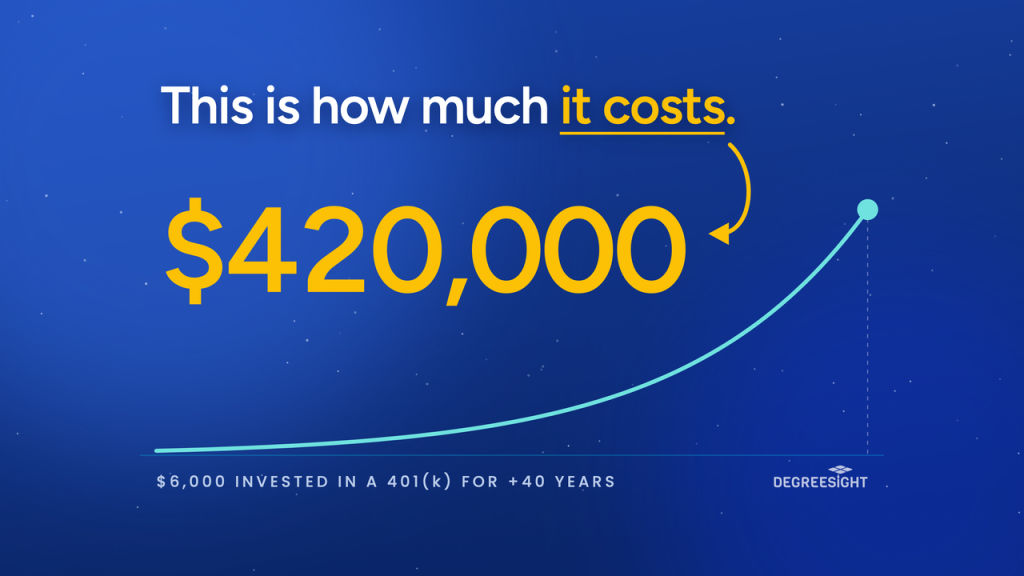
So what happens when a student does not graduate on time? One delayed year can create a lifetime financial impact of about $420,000 by age 65. Not for the institution. For one student.
Finishing late is the default
Finishing late is not the exception. It is the norm. About 61% of students complete a bachelor’s degree within six years. At public four-year institutions, less than half complete within four.
Federal reporting reinforces the pattern. A student counts as “on time” at 150% of the program length. For a four-year degree, that is six years. Most students never beat it, and almost none see the true cost coming.
Where the money goes
The financial impact of one extra year comes from three places: another year of college, lost first-year earnings, and missed retirement growth.
1. Another year of college: about $30,000
College Board puts the average annual student budget for an in-state student at a public four-year institution at about $31,000 for 2025-26. Tuition, fees, housing, food, books. At a private nonprofit institution the same budget is about $65,000. An extra year means paying it one more time, often with new debt, and the interest on that larger loan balance keeps accruing for years, quietly inflating the true cost well beyond the sticker price.
2. The first paycheck that never arrives: about $62,000
NACE puts the average starting salary for the Class of 2025 near $68,000. A student who graduates a year late does not earn that first year. A graduate who contributes 6% of that pay to a 401(k) and receives a typical 50% employer match invests roughly $6,000 in the first year on the job. Set that $6,000 aside, and the remaining $62,000 is first-year income that is simply never earned.
3. The retirement growth that never starts: about $329,000
This is the largest cost, and the one nobody sees. Take the $6,000 that would have gone into a 401(k) at age 23. At the S&P 500’s historical average of about 10% a year, that single contribution grows to about $329,000 by age 65, 42 years later. Graduate a year late, and that first year never starts. The student does not lose $6,000. They lose everything that $6,000 would have become, because the first year of saving is the single most valuable year they will ever have: it has the longest runway to compound. A year lost at the start of a career can never be repurchased at the end of one.
Adding it up
| Cost | Per student |
|---|---|
| One more year of collegeCollege Board 2025-26 average student budget, in-state public four-year | $30,000 |
| First-year earnings lostNACE Class of 2025 average starting salary, minus $6,000 set aside for retirement | $62,000 |
| Retirement growth never started$6,000 at about 10% a year, age 23 to 65 | $329,000 |
| One extra year, by age 65 | about $420,000 |
Nearly four of every five of those dollars is investment growth the student never gets to begin. Time, not tuition, is the real cost of an extra year.
It is not only financial
The costs of delay are not only measured in dollars. An extended timeline quietly erodes the motivation and well-being a student needs to finish at all.
- Motivation erodes. Every extra semester extends the period of tuition bills, loan accumulation, and economic uncertainty. Research consistently links that sustained stress to lower academic performance, and the longer a degree stretches, the more it feels like a burden rather than a goal within reach.
- Confidence in the payoff fades. As costs mount and graduation recedes, students ask whether the degree is “worth it.” That doubt is one of the strongest predictors of dropping out, turning a delay into an abandonment.
- Life gets put on hold. A later start to earning and investing cascades into delayed home ownership, family formation, and wealth-building. Like the retirement shortfall, that gap never fully closes.
The greater risk is no degree at all
An extra year is the good scenario. Every extra term raises the odds that a student never finishes. About 37 million Americans under 65 have some college, no credential, and are no longer enrolled. Many carry the debt with none of the degree’s payoff. It is one of the worst possible outcomes of a higher-education investment.
Why it matters to your institution
On-time completion is not only a student outcome. It is an institutional one. For your institution, timely completion affects retention, funding, reputation, and mission.
- Completion and retention are the metrics behind rankings, accreditation, and performance-based funding.
- Net tuition revenue and capacity. Students who finish on time free seats for the next cohort instead of re-consuming resources.
- Equity. Delay hits hardest the students least able to absorb another year’s cost, and they are precisely the ones most likely to be pushed off-track by it.
This is not about rushing students or cutting corners. It is about removing structural friction: unclear degree pathways, courses that do not count toward a major, transfer credit that is lost or unrecognized, and advising that catches problems a semester too late. These are solvable, structural problems, not student failings.
The scarcest resource is not money. It is time.
Make the path visible
When students can see a clear path to their degree, when every credit they have earned is recognized and applied, and when transfer pathways are transparent from day one, the extra year stops being the default. On-time graduation is the single point where student well-being, institutional performance, and economic mobility all align. It deserves to be treated as a strategic priority, not an afterthought.
That is the work DegreeSight exists to do: making degree pathways visible, recognizing every credit a student has earned, and turning transfer from a source of lost time into a source of momentum. See a demo or get your Transfer Friendliness Assessment below.