

With insights from Charles Ramos, Vice President of Partnerships at DegreeSight
For most VPs of Enrollment, the real conversation about enrollment recovery starts the week census numbers land. Classes are underway, the fall class is almost final, and presidents, provosts, and boards already want to know what happens next.
That is the moment Charles Ramos, Vice President of Partnerships at DegreeSight, wants enrollment leaders to think differently. After nearly 30 years consulting for colleges on traditional, transfer, and adult recruitment, his advice is direct: whether you hit your goal or missed it, enrollment recovery does not have to wait a full cycle. It can start this spring.
What You’ll Find in This Article
- Why the weeks after census set the agenda for the next 12 months
- What institutions that hit their goals should check before they celebrate
- How a spring enrollment recovery plan can close part of a fall revenue gap
- Why adult and transfer students are the most overlooked lever in the market
- Why your website is a stronger enrollment recovery tool than a last-minute name purchase
- How to build an enrollment portfolio that can absorb a bad year
Census Week Is When the Year Becomes Real
Census removes the guesswork from enrollment recovery planning. “It’s going to be in the next few weeks where the rubber hits the road,” Ramos said in early September. “They’ll have absolute clarity once census hits as to what those numbers are and the implications those numbers have on revenue, and on the overall financial stability of the institution.”
It is a nerve-wracking stretch, and more so for schools that also saw weaker than expected retention. Every student who does not return is revenue that has to be replaced, which is why enrollment recovery is a retention conversation as much as a recruitment one.
In a July 2026 Niche survey of 134 enrollment leaders reported by Inside Higher Ed, 61 percent said they met their fall 2026 targets. Among colleges with fewer than 2,000 students, only half did. Roughly four in ten institutions begin the next cycle already behind.
“Presidents, provosts, boards are really pushing VPs of enrollment to pull a rabbit out of a hat,” Ramos says. “Institutions expect to make up the difference with more enrollment, and some markets just aren’t there to sustain those numbers.”
The question is what your enrollment recovery plan looks like for the next 90 days.
If You Hit Your Number, Look Under the Layers
“For schools that hit their enrollment targets, the celebration lasts about two minutes,” Ramos says.
The first reason is competitive. With fewer high school graduates to go around, first-year recruitment is a zero-sum game. Your growth came from somebody else’s class, and a savvy VP of Enrollment at that school knows exactly who took their students. “If you’ve done well this year, you have to recognize that you have a target on your back,” Ramos says. Their enrollment recovery strategy will target your markets with sharper marketing and more aggressive aid offers.
The second reason is internal. Ramos compares enrollment results to an onion rather than an orange. You do not peel one layer and find the fruit. You hit your headcount, but did you hit your revenue goal? Did your discount rate climb to get there? Did the academic profile of the class slip?
Only 48 percent of colleges that emphasized increased discounting hit their deposit targets, compared with 67 percent of colleges that avoided heavy discounting. Ramos made the broader case in his earlier piece on why the answer to a 57 percent discount rate is not a bigger discount.
This is why enrollment recovery thinking matters even after a good year. Transfer and adult students, Ramos notes, “are traditionally coming in at 10, 15 percentage points, sometimes lower” in discount rate than the first-year class. For enrollment recovery, that means more net revenue per student, not just more headcount.
If You Missed, Your Enrollment Recovery Starts in Spring
For institutions that fell short, the first step is an honest post-mortem. Which markets did not grow? Who did you lose students to, and why? Are you collecting data from admitted students who chose not to come, and is that data shaping your enrollment recovery plan?
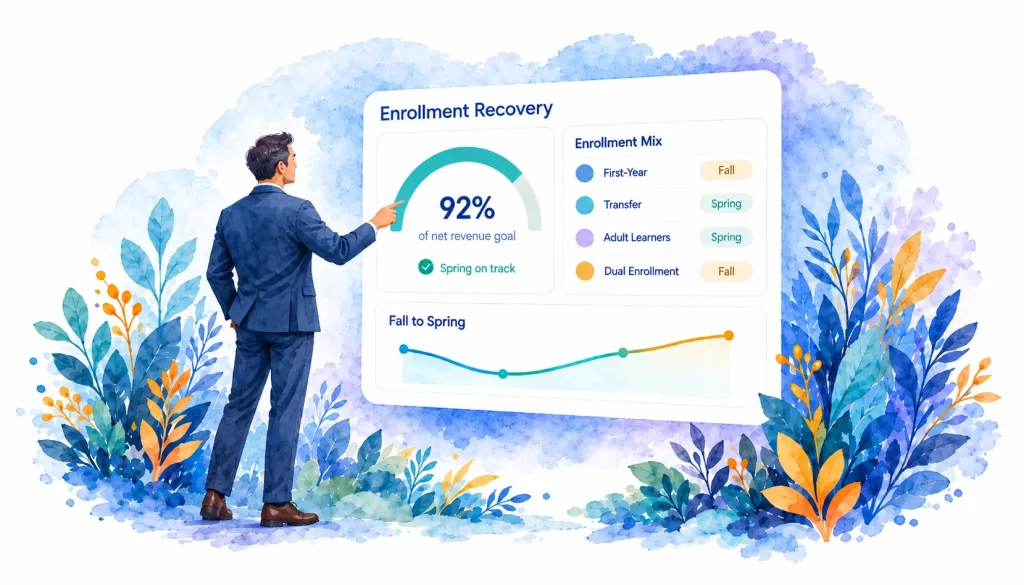
The second step is rethinking the calendar of enrollment recovery. “Schools don’t need to wait another year to try to make back what they’ve lost,” Ramos says. “For spring, some of that enrollment can help mitigate, if not sometimes completely balance out, the revenue shortfalls incurred in the fall. And so many schools just don’t think that way.”
Adult and transfer students do not follow that calendar. They decide when life allows it, which makes spring a real enrollment recovery window rather than an afterthought.
The 37.6 Million Adults Most Colleges Are Not Recruiting
The National Student Clearinghouse Research Center counts 37.6 million working-age Americans with some college and no credential. In the 2023 to 2024 academic year, just over one million re-enrolled, roughly 2.7 percent. It was a record, and it still left most of that population untouched. For enrollment recovery, that gap is the opportunity.
Ramos believes higher education owns part of that gap. “We, as enrollment management professionals and as institutions, have really not concentrated our efforts on getting these individuals to see that higher education is still an option for them,” he says.
One VP of Enrollment put it to him more bluntly: their work with transfer and adult students seemed to mimic what they were doing in the 1990s. “That market thinks and acts very differently than it did 30 years ago,” Ramos says, “and yet we in higher ed have done very little to adjust.”
The Clearinghouse data also shows where enrollment recovery efforts should begin. Students who stopped out with two or more years of credit are more likely to re-enroll and more likely to finish. These are not cold prospects. They have transcripts, momentum, and a reason to come back, if an institution can show them the path.
Why Returning Adults Want Proof of Value First
Adult learners usually pay their own way, and they evaluate a degree like any major purchase. Georgetown University’s Center on Education and the Workforce found that bachelor’s degree holders earn 84 percent more over a lifetime than workers with only a high school diploma. “A student who graduates with a college degree is going to earn, on average, over a million dollars more over a lifetime,” Ramos says.
But a strong case only works when it is made clearly for this student. That is where most enrollment recovery plans break down.
Why Late Name Buys Will Not Drive Enrollment Recovery
When the numbers look soft, the reflex is to buy more names. Ramos is skeptical that it helps enrollment recovery. “Late name purchases really don’t do much at all,” he says. “They’re traditionally very low return.”
The better enrollment recovery opportunity is already on your website. Every day, prospective students arrive through organic search and leave without anyone knowing who they were. Ramos calls them stealth visitors, and many are asking one question: how does the work I have already done count toward a degree here?
“If a student doesn’t find what they’re looking for within two or three clicks, they will abandon the search,” Ramos says. And when schools do publish the information, it is often buried in equivalency tables that take an hour to cross-reference. “You think a student is going to want to spend that kind of time on your website? Absolutely not.”
He describes the website as a window into the institution. Some visitors look in and see a clean, well-kept home. Others see boxes everywhere and cannot tell the front door from the closet. The fastest enrollment recovery lever is not more traffic. It is making sure the traffic you already have finds what it needs.
This is the thinking behind real-time credit estimates on the institution’s own site. When Roosevelt University launched DegreeSight Inbound, it generated 561 transfer leads with 84.8 percent of evaluations automated at launch. Those students were already browsing. The website finally answered them. For more, see how enrollment leaders are generating more transfer leads without buying lists.
Students Now Shop for College Like Everything Else
Adult learners, transfer students, and increasingly first-year families treat higher education as something they buy, not an honor they are granted.
“They’re going to treat you as an institution the same way they treat Amazon, Starbucks, Netflix,” Ramos says. The mobile order is waiting at the counter. The recommendations are ready before you search. The cup has your name on it. “Whether this is fair or unfair, it’s the reality of where the market is right now.”
That reality shapes every enrollment recovery strategy in three ways. The first is value. Most institutions communicate their features and do a poor job of explaining why those features matter to this student. A returning adult wants to know how quickly they can finish, what their prior credits are worth, and how the degree changes their position in the job market.
The second is speed. Students judge the whole experience by the enrollment process. “If the enrollment process is laborious, if it’s slow, they’re going to associate that that’s what their experience is going to be like once they enroll,” Ramos says, “and the likelihood of their enrolling diminishes significantly.”
The third is personalization. Ramos frames the combination as credit transparency, expediency, and personalization, and together they signal authenticity. The bar is not perfection. “If the next institution does a slightly better job than you,” he says, “they’ve already won.”
Treat Your Enrollment Recovery Strategy Like a Portfolio
Ramos returns to one enrollment recovery principle for every institution, winners included: diversify. “What happens if you have a bad year? Do you have enough diversity in your revenue?” he asks. “It’s the same as investing in the stock market. Are you going to invest all in one company?”
A resilient portfolio balances first-year students with transfer students, returning adults, and dual enrollment students who arrive with credit in hand. Each segment follows a different calendar and carries a different discount profile. When one underperforms, the others absorb the impact, and enrollment recovery stops being an emergency.
Diversification also applies to academic programs. Do they match what students and employers need today? And it requires budget discipline. “They can’t always put it on the backs of the student,” Ramos says.
Set Your Enrollment Recovery Baseline Now
The best time to measure a new strategy is before you launch it. Ramos recommends capturing a baseline this fall: total enrollment, net tuition revenue, and discount rate, broken out by first-year, transfer, and adult students. Next fall, that baseline turns a hopeful enrollment recovery story into a documented one you can bring to your cabinet and board.
What This Means for the Next 90 Days
The institutions with the fastest enrollment recovery will not be the ones that find a bigger list or a deeper discount. They will be the ones that stop treating enrollment as a single annual event. Census tells you where you stand. It does not decide where you finish.
A spring enrollment recovery plan built on adult and transfer students can protect this year’s revenue. A diversified portfolio can protect next year’s. And a website that answers the question every returning student is asking can do both, often with traffic you already have.
When a student can see the path, understand the value, and get a fast, personal answer, the institution earns their trust. Without that, Ramos says, “they’re not going to spend the time to figure it out. They’re just going to go on to the next one.”
If your current process is creating friction in your enrollment funnel, a Transfer Friendliness Assessment can help identify where you are losing students, and how to fix it.